Sunday, September 14, 2014

Learn for yourself


That is what Vanguard is all about, learning for yourself, right?
 
From the amazing Becky Edwards:
 
19 Power-packed questions to help you "learn for yourself" when you have a question for God. Joseph Smith's First Vision story has hidden gems of invitations to act. 

Thursday, September 4, 2014

The Weight of a Snowflake

Do you ever feel like what you do just doesn't matter?

Check this article by Stephen Palmer out!

"Four "Nothing" Habits That Can Change Everything"


The story is told of a sparrow and a dove perched on a branch in the winter.
“Tell me the weight of a snowflake,” the sparrow asked the dove.
“Nothing more than nothing,” the dove answered.
“In that case I must tell you a marvelous story,” the sparrow said.
“I sat on a fir branch close to the trunk when it began to snow. Not heavily, not in a raging blizzard. No, just like in a dream, without any violence at all.
“Since I didn’t have anything better to do, I counted the snowflakes settling on the twigs and needles of my branch. Their number was exactly 3,471,952. When the next snowflake dropped onto the branch — nothing more than nothing, as you say — the branch broke off.”
Having said that, the sparrow flew away.
The dove, since Noah’s time an authority on peace, thought about the story for a while. Finally, she said to herself, “Perhaps there is only one person’s voice lacking for peace to come to the world.”
Like snowflakes accumulating on that branch, your life does not change, your greatness is not unleashed by monumental actions, but by small, daily habits.
Here are four specific habits whose value will accumulate in your life like “nothing more than nothing” until, after years of steady discipline, will break your limitations and emerge as greatness:

1. Read

Reading the best books immerses you in the thoughts of the best thinkers, saturates you with the courage of the greatest souls.
Whatever you put into your mind emerges as behavior. You can’t read C.S. Lewis without grasping for heaven. You can’t read Viktor Frankl and not exercise your power to choose more wisely. You can’t read Rabbi Daniel Lapin without changing how you think about and spend money.
Every great book read is a snowflake falling on the ceiling of your limitations. Read one per week for five years and watch that ceiling crack.

2. Meditate

You are not your body; you have a body. You are not your mind; you have a mind. You are the “I Am” that observes the thoughts in your mind.
Your mind is a fabulous servant but a horrible master. It tends toward negative thinking and is plagued by fear, doubt, and worry. It holds you captive to your emotions.
To access your greatness you must transcend the negative-thinking mind. Meditation is the single most powerful tool for doing so.
Sit still in a quiet solitude and meditate for just ten minutes a day and watch the snowflakes fall…

3. Change Your Morning Routine

Leadership expert John Maxwell said,
“You will never change your life until you change something you do daily. The secret of your success is found in your daily routine.”
The most important thing you can change in this regard is your morning routine.
Make it a habit to get up an hour or even a half hour earlier than usual. Start your day with a prayer of thanksgiving. Meditate. Read. Exercise.
Do that every day for three years and you’ll feel branches of limitations snapping in your life.

4. Follow Spiritual Promptings

Call them whatever you’d like. Hunches. Intuitions. Sparks of inspiration. Whispers of conscience.
You feel them. Do you follow them?
You once had the thought to write a book. Have you written it yet? Something told you to stop when you saw that car on the side of the road with its flashers on. Did you stop?
The more quickly, courageously, and zealously you follow those promptings, the more of them you receive. The more you receive and follow, the faster your acceleration to greatness. Conversely, the less you follow these, the less you receive, the more you stay stuck.
Like the weight of one snowflake, the impact of any action taken one time is “nothing more than nothing.” But the impact of wise, daily actions cultivated into habits and lived for years is enough to break your limitations and change everything.
 

Tuesday, August 12, 2014

John Taylor quote

Thanks, Suzette!
 “We ought to foster education and intelligence of every kind; cultivate literary tastes, and men of literary and scientific talent should improve that talent; and all should magnify the gifts which God has given unto them… If there is anything good and praiseworthy in morals, religion science, or anything calculated to exalt and ennoble man, we are after it. But with all our getting, we want to get understanding, and that understanding which flows from God.”
 -John Taylor
 I hope everyone is having an inspiring time getting a new year ready :).

Friday, August 1, 2014

Why Learning Styles Matter


I find that one of the biggest challenges in creating a true Vanguard environment is found in trying to implement different styles of learning effectively.  We tend to default to traditional lecture and discussion, and, by doing so, miss out on the beauty of exploring other learning styles and environments.Learning Styles Matter Mentors failure 1024x569 Learning Styles Matter! The Weekly Mentor by Oliver DeMille
Reading a recent post by Oliver DeMille reminded me of the chart in the book by Neil Flinders, showing that there is obligation by both the mentor and the learner to come together.  Oliver DeMille gives some great steps to how to implement different learning environments into your group.

Please take the minute to scan through the article below, because learning styles do matter! :)

Learning Styles Matter! The Weekly Mentor by Oliver DeMille


Draw a Picture

“But I told him exactly what to do,” I said slowly, emphatically. “I even repeated it, then had him echo the expectation back to me to make sure he got it.”
I shook my head in frustration. “Four hours later, and he only did a little bit of it.”
The more I talked this way, the more I became convinced that my son Ammon had just decided to goof around instead of do his assignments. Naturally, my emotions started adding to my exasperation. At this point I began to get cross. “If he doesn’t finish in the next hour, I’m going to triple his chores this week,” I told Rachel.
I put a lot of ire into the word “triple.”
Rachel looked at me calmly and asked, “Did you draw him a picture?”
“What?”
The truth is, I immediately knew what she meant. It hadn’t even crossed my mind until she brought it up, but I instantly realized that I was the problem—not my son. Still, I was feeling emotional, so I kept the conversation going.
“You know, a picture. He never gets it from words. He’s just not auditory.” Her relaxed voice calmed me down, and I nodded my head.
“I know, I know. I just forgot. I was in a hurry, and I didn’t even think of it. I just told him what I wanted him to do, and had him repeat it back to me. It would have worked with anyone else…”
I paused, then corrected my statement. “At least, with anyone who is Auditory.”
We both laughed, and I went to find Ammon and draw him a picture of what I wanted him to do.
An hour later, he happily brought me his work. I studied it closely. “Well done, son! Excellent, in fact.” He smiled broadly.
I told Rachel, “It’s amazing how well he does when he knows what’s expected.” We both grinned. Ammon isn’t the only one. This is true of pretty much everyone. At the very least, people generally do better when they understand what is wanted than when they have no clue!

Making it Simple

This experience reminded me of how often people ask us if TJEd teaches anything about learning styles. Well, yes it does. Specifically, great education means personalizing the education of each and every student.
There. That’s learning styles. Every student is different. And individualizing his/her schooling is absolutely vital to great education.
But it goes even further. There are several major learning styles, and trying to teach a student in a style that he doesn’t really understand is a recipe for frustration—and often failure. But the failure is the mentor’s fault, not the student’s.
To make it simple, most students fall into one of five (actually six, but more on this later) main categories of learning. These styles include:
• Visual: Learns by seeing. You have to draw them a picture, or show them the map of what you want done. Once they really “see” the goal in their mind’s eye, they’ll tenaciously go after it. But unless they see it, they’ll never pull it off. If you want them to read a lot of books and do a bunch of math studies, for example, you’ll need to introduce them to a role model—someone who did these things well while young and now is achieving the things your student wants to accomplish or have. No picture—no progress. For Visual learners, a picture is worth more than a thousand words. Show them!
• Auditory: Learns by hearing. Can soak up hours and hours of audios, and repeat what they’ve listened to almost verbatim—even months or years later. Audio learners are usually easy to spot. Start playing lots of audios, and they’ll get really interested and want more. Very often Auditory learners are among the worst “official” students, unless their parents or teachers know that they need an auditory approach. With this, they’ll frequently become some of the best students. Just plug in a CD and they’ll passionately learn, learn, learn.
• Literary: Learns by reading, and by writing. Enough said. In our modern schooling system, these learners are nearly always considered the “good” students. But this is because of the system, not because Literary learners necessarily know more. To help these students, give them resources and opportunities and give them time. Provide one-on-one help as requested. And get out of their way. They love book learning, and can’t get enough of it. They frequently thrive on fulfilling assignments and being praised by adults, so it is important to go beyond mere grades/rewards and challenge them to really think for themselves. Verbally question them a lot about what they read—and what they personally think about it.
• Spatial/Mathematical: Learns through abstract models, such as numbers, shapes, maps, charts, gaming (from chess to manipulatives, etc.) and imaginary worlds/scenarios (the more fictitious the better). These students are easy to spot, even if you’re a dyed-in-the-wool Literary learner. The first step to mentoring success with such learners is to connect with them—usually by mapping on to their interests in SciFi or something else they really enjoy. They tend to love the two ends of the spectrum—highly proven scientific/mathematical reality, and totally imaginary alternative universes that belong only to fantasy. They often struggle to care about anything in between. In other words, Spatial/Mathematical learners tend to strongly value both reality and idealism, but are skeptical of the pragmatic things in life.
• Active: Learns by doing. Projects, simulations, workshops, one-on-one apprenticeships working directly with a mentor, hands-on practice, etc. If they can do it with their hands, they’re in. If not, it’s pretty much just “boring.” These learners love doing things, from athletics to computers, or theater to camping. They are sometimes hard to recognize because their interests vary widely, but their methodology doesn’t. For them, “doing is learning.” Classrooms are typically their worst nightmare, but they love labs or hands-on environments. For example, put them in a class or on a couch using a textbook to study chemistry and they’ll hate it (and probably not learn much), but turn the same study into a lab (even with the same teacher and topics) and they’ll shine.
So how does an adult teach students from all these types? Truth: most teachers don’t. In a homeschool setting, it’s a lot easier. Just focus on the individual needs of each student.

Personalized. Personal. Real.

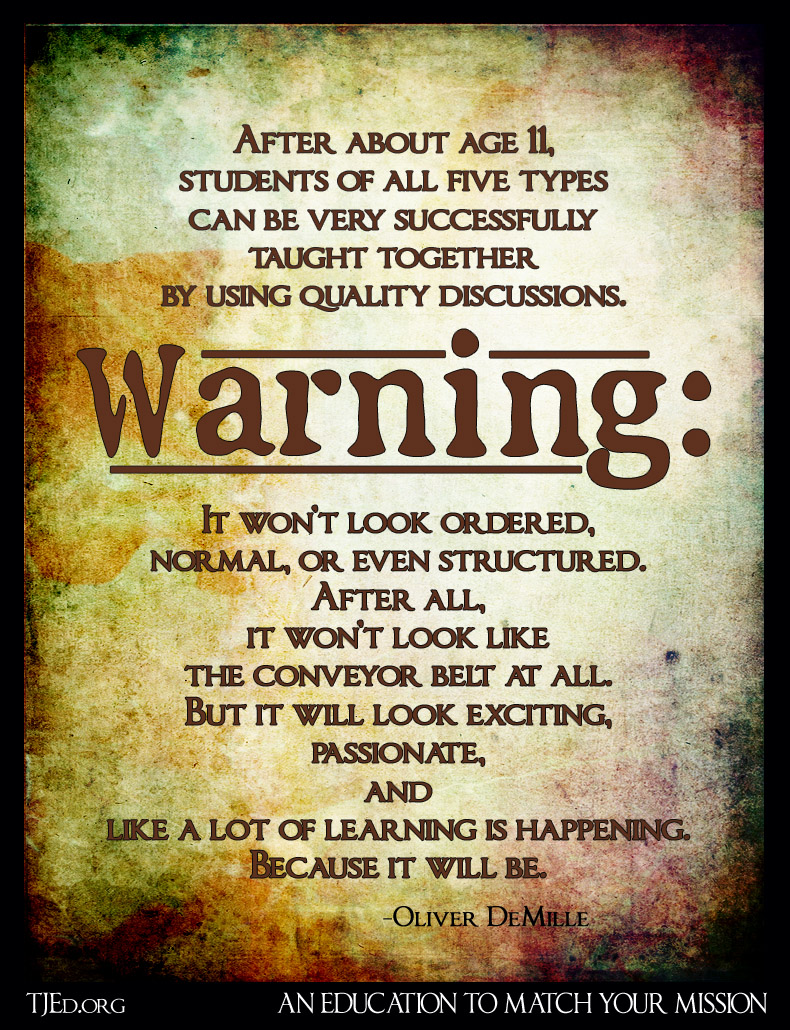
Learning Styles Matter Discussions 785x1024 Learning Styles Matter! The Weekly Mentor by Oliver DeMille In a private or public school, this can be more difficult. But there is an effective shortcut. After about age 11, students of all five types can be very successfully taught together by using quality discussions. This has to be done daily, or at least several times a week, to build momentum, and the parent or teacher needs to teach the students how to effectively use discussion.
The best way to do this is to start the discussions by talking about the five learning styles (we’ll learn about the sixth type below). Each student gets to decide which most effectively describes him, and share it with the class.
This is actually a literary exercise for Literary learners (who are asked to read about learning styles before the discussion), an active exercise for Active learners (who learn the most by sharing their styles with the class), an auditory event for Auditory learners (who later detail the whole discussion to their little brother or someone else), and a visual process for Visual learners (hand out a chart of the 5 types, arranged in a circle or pyramid or whatever—be creative—with bullet points about each type).
As for Spatial/Mathematical learners, tell them at the beginning of class that there is a hidden pattern in the room—based on the makeup of class members and their learning styles—and it is their job to figure it out and present the pattern to the group the next time you meet. For example, invite them to analyze the way “power” flows through the discussion – sometimes resting with someone who is silent, sometimes with someone who is vocal. They’ll stay up nights excitedly outlining the incredible patterns that in fact do exist in every group. You’ll be amazed at what they come up with.
During the second discussion, have the group brainstorm ways to make the next class period excellent for people from all five learning styles—and any other learning styles they come up with (there is a sixth, Creative style hidden away and spread through the other five styles—but you don’t have to do much with them, just don’t get in the way of their learning). Repeat this with every book and assignment you discuss.
The discussions will be world class. The parent or mentor will spend a lot of fun time planning how to reach each student (which is, after all, what it means to “mentor”), and the students will watch their learning soar!
This is great education.
Try it!

Warning:

It won’t look ordered, normal, or even structured. After all, it won’t look like the conveyor belt at all. But it will look exciting, passionate, and like a lot of learning is happening. Because it will be.
And, actually, it will require more structure, creativity and leadership than the conveyor belt ever achieves. It will work, because the mentor will help each student get the kind of education he/she really needs. Personalized. Personal. Real.
Will it always be perfect? No. But it will be better than most of what happens in most modern classrooms.
Like I said, try it.
Do try this at home. And try it in the classroom, and anywhere else great learning is wanted.
Great education is always personalized, and when we focus it on the real needs of each student—including his or her main learning style—it can be outstanding.

Thursday, July 3, 2014

Inspiring quotes gathered by Suzette Liu

"A person may profit by noticing the first intimation of the spirit of revelation; for instance, when you feel pure intelligence flowing into you, it may give you sudden strokes of ideas, so that by noticing it, you may find it fulfilled the same day or soon; (i.e.) those things that were presented unto your minds by the Spirit of God, will come to pass; and thus by learning the Spirit of God and understanding it, you may grow into the principle of revelation, until you become perfect in Christ Jesus."
 
-Joseph Smith Jr. "Teachings of the Presidents of the Church, Joseph Smith", p132.
History of the Church, 3:381; from a discourse given by Joseph Smith on June 27, 1839, in Commerce, Illinois; reported by Willard Richards.
 
**********
 David O. McKay:
“Next to being one in worshipping God there is nothing in this world upon which the Church should be more united than in upholding and defending the Constitution of the United States” --David O. McKay
 
“I will raise my voice as long as God gives me sound or ability, against this Communistic idea that the Government will take care of us all, and everything belongs to the government. It is wrong!”
 
“Wisdom is the right application of knowledge; and true education...is the application of knowledge to the development of a noble and Godlike character.” 
 
“A man may possess a profound knowledge of history and mathematics; he may be an authority in psychology, biology, or astronomy; he may know all the discovered truths pertaining to geology and natural science; but if he has not with this knowledge that nobility of soul which prompts him to deal justly with his fellow men, to practice virtue and holiness in personal life, he is not a truly educated man. "Character is the aim of true education; and science, history, and literature are but means used to accomplish the desired end. Character is not the result of chance work but of continuous right thinking and right acting.

"True education seeks, then, to make men and women not only good mathematicians, proficient linguists, profound scientists, or brilliant literary lights, but also honest men, combined with virtue, temperance, and brotherly love-men and women who prize truth, justice, wisdom, benevolence, and self-control as the choicest acquisitions of a successful life.”
 
 
***********
 
Thanks, Suzette, for gathering these! 

Friday, June 6, 2014

Notes from "Teach the Children"

A tantalizing tidbit before you start studying!

"The purpose of education is to help man reestablish proper relationships with himself, his origins, his fellow men, and his living God." pg 215

"Most of us preoccupy ourselves with what we are going to do during the upcoming class time.  More productive is the concern with what are the students going to do.  Emphasis on the latter stimulates the teacher to consider how to invite learning involvement.  Student rather than the teacher of the subject matter become the focal point in planning." pg 221

"In moral matters, teachers are their own best teaching tool.  And personal morality applies to the teaching of any subject. The effective agency teacher teach all subjects as components of character....this is the optimum kind of teaching  to influence character.  As they radiate, teachers give of themselves to others without demanding any return.  They lose themselves in service, and in so doing find their best self.  Free from the numbing fear shown in stage fright, lack of confidence, and the inhibition of self-consciousness, teachers join the students on their side of the fence, see life through their eyes and enjoy sharing in their experiences." pg 227

Referring to the power of a teacher who reaches out with love to their students, "Students have access to this same power...Students love expressed toward teachers has the power to lift those teachers above their own limitations.  Students who reach out and embrace the good a teacher has to offer may find that their learning will exceed the limitations of both themselves and their teacher." pg 228

After a great break-down of why the lenses (pg 234-236...Leadership Academy is the "morality/fifth aspect" he refers to on page 231 and then expounds on 238), Flinders says: "Too often, teachers and students become lost in the curricular means and fail to recognize that it is the general capacity and not a particular application of the capacity that we need to develop.  The details of school studies are soon forgotten; it is the expanded capacity that remains to enrich our lives." (pg 237)

Pg 272 he addresses how to have an effective interview between mentor and student, along with some great questions about evaluating the relative "importance" of creating as part of the educational process. I find my children are natural creators after being exposed to information in a spiritual, impactful experience and the process of creating may be beautifully summed up in the book "Get Busy Beaver"....basically, sometimes you cannot measure the creative process by "normal" standards and may be frustrating.  Great section to read...through 281: "Creativity is simply the act of organizing existing elements for some purpose."

"Education (is) the conscious and intentional interaction with the messages of others...If there are no messages, there can be no education...Effectively connecting messages and purposes is the trademark of good scholarship." pg 304

"True scholarship is open, inviting participation from all who are willing and interested." pg 305

"True scholars create, report, explain, and clarify; they listen, comprehend, confirm, correct, and reject.  To engage in debate, disputation, argument, contention, self-serving salesmanship, and other forms of intellectual compulsion is not scholarship--it is rhetoric...honestly revealing information that may be personally validated or invalidated by others is scholarship....In this type of environment positive relationships rather than adversarial relationships are fostered." pg 309-310

"If you are a humble follower of all truth, the doors are wide open.  The Lord will help us use our talents to inspire one another in all kinds of things." (quoting David Allan on page 311)  Powerful personal examples from others on page 311-315, a mom, a teacher, and a scientist.

Page 320-321: How to prepare for classes
Make the experience before class and during interactive: page 323

Thursday, June 5, 2014

Protectors of the Environment

That's what we are as mentors: protectors of the environment. 

And I don't mean like Green Peace or treehuggers.

Our job as mentors in Vanguard is to create and protect and environment of respect and inspiration that will allow the youth to find and explore their God-given genius--using their agency--and to learn enough principles of freedom to be able to protect their rights to use than genius.

I have been reflecting on this truth a great deal as I head into the new year.  As a protector, it is not always an easy, safe, or comfortable job.  However, as I turned to the scriptures this morning to try and keep my purpose Christ-like, I felt directed to the following two scriptures:

3 Nephi 12:48/Matt. 5:48: Therefore I would that ye should be perfect even as I, or your Father who is in heaven is perfect. ("Perfect" in the original Greek:"complete, finished, fully developed")
High, even idealistic standards!

3 Nephi 27:21: ...for the works which ye have seen me do that shall ye also do; for that which ye have seen me do even that shall ye do.
My mind went to the cleansing of the temple, one of the few times we see Christ full of wrath and indignation in the scriptures.  He was protecting the sanctity of the environment of the temple, and we should do the same with our classes.

Cell phone use, attendance, behavior in class and treatment of peers...these are all hard and challenging issues and must be considered on a group by group basis.

However, we must not be afraid to expect standards in the group that protect that learning environment.  We do not ask for a $1000/semester tuition, but I feel that the quality of what we can offer is worth the commitment of time and sacrifice that high, idealistic standards demand.   We must be mindful of this so that our groups do not deteriorate into play-dates for our youth...unless that is what you want, of course :).   

Remember that rules and standards are not terrible if righteously established and followed through with.   In fact, it is moral rules and standards that made our nation great. It is religious rules and standards that demand the sacrifice it takes for sanctification.  Every institution and organization has basic standards that define it and establish a ground level for its membership.

As we review or establish our bylaws for the year, may we prayerfully consider what kind of environment we feel is necessary in our group to protect the mission of Vanguard:
We will engage in a respectful and inspiring peer environment that will not only help us grow in our faith, but will help us feel free to develop our unique strengths
as well as a passion for learning that will allow us to better ourselves, our families, our communities, and, ultimately, the world.

(Check out the quote by Orson Whitney on page 229 of "Teach the Children"...it goes beautifully with this and expands on the instructor's role to "cultivate, nourish, care for and protect [the student], places them in those conditions where they can best expand according to the laaws of their own being.")